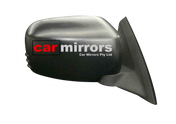
Side Mirror Cover Scratched or Cracked? What to Do
By Duber, The Car Mirror Man · Car Mirrors Australia · Updated August 2026 · 13 min read
Short answer: the cover is a separate, clip-on part. A scuff is cosmetic and changes nothing mechanically or legally. A crack through the plastic is worth replacing, because it lets water into the housing and because the cover is what holds the indicator repeater on most cars. A cover on its own is $150 to $300 — a long way below a full assembly.
In Sydney? We can swap a scuffed cover without a new mirror at your home or work, anywhere across the metro — see our full Sydney mirror service.
Of the five layers in a side mirror, the cover is the one that meets the pillar, the trolley and the gatepost first. It is designed to. What it is not designed to do is stay watertight once it has been cracked, and that is the difference between a scuff you can ignore and damage worth dealing with.
Where the cover sits in the mirror
It helps to see the mirror as a stack rather than a single component, because that is what makes a cover-only replacement possible in the first place.

A knock that leaves a mark on the cover has, in the great majority of cases, done nothing at all to the three layers behind it.
Scuffed, cracked or gone
Three states, and only two of them need action.
| State of the cover | What it means | Action |
|---|---|---|
| Scuffed or scratched | Paint transfer or surface marks. Structurally intact. | Cosmetic. Replace only if it bothers you |
| Cracked | Split through the plastic, or a piece missing. | Worth replacing. Water gets in |
| Gone | Cover has detached and is not on the car. | Replace. The internals are fully exposed |
| Loose or rattling | Clips broken but the cover is still there. | Replace or re-clip. It will leave at speed |
The middle two are the ones that matter, and both for the same reason: a mirror housing that is no longer sealed is a container collecting water directly above a motor and a wiring connector.
What a cover swap actually looks like
It is one of the more satisfying small repairs, because the difference is total and the cost is not.

The old cover unclips, the new one clips on, and where the repeater is a separate strip it transfers across. On most vehicles it is about thirty minutes at the kerb with the glass and the motor never touched.
Painted, unpainted and colour matching
This is the one part of a mirror job where genuine parts genuinely matter, and it is worth understanding why.
If the original cover has come off in one piece, keep it. It is the fastest way to confirm the exact part and, on some vehicles, the colour code is moulded into the back of it.
Why a cracked cover is not just cosmetic
Three consequences, none of which are obvious from the outside.
The housing is not sealed any more. The adjuster motor and its connector sit in the bottom of it.
On cars where the indicator strip lives in the cover, a crack alongside it lets moisture into the module.
A cracked cover flexes. Flexing works the remaining clips loose, and eventually the cover departs at speed.
Every one of the above turns a $150 to $300 job into something further up the ladder.
Is a damaged cover a legal problem?
A scuff, no. The design standard is concerned with the mirror giving the driver a view of the road behind [1], and a scratched cover does not affect that at all.
A cover that is loose, hanging or missing is different. A safety inspection checks that the mirror is firmly mounted [6], and a housing that is coming apart can fail on that basis. A mirror in that state can also attract a defect notice [5], and a piece of cover leaving a car at speed is its own hazard.
The practical line: if it is still one piece and firmly attached, it is a cosmetic decision. If it is flapping, it is not.
Can a scratched cover be repaired instead of replaced?
Sometimes, and it depends entirely on what the scratch went through.
Surface marks in the clear coat can often be polished out, and paint transfer from another vehicle frequently comes off with a solvent and patience rather than anything more drastic. That is a genuinely free fix worth trying before you spend anything.
Once the scratch is through the colour coat into the primer or the raw plastic, polishing will not bring it back, and a repaint of a small moulded part usually costs more than a replacement cover. That is the point where swapping the part is the cheaper answer as well as the better-looking one.

Aftermarket covers and stick-on caps
There is a large market in cheap replacement caps and chrome covers, and it is worth knowing what you are getting.
The stick-on caps are the ones that cause us work later. They hide a cracked cover rather than fixing it, and the water carries on doing what it was already doing.
What a cover costs
Second lowest-cost thing on the mirror, after the glass.
| What is being replaced | What it covers | Price |
|---|---|---|
| Glass only | Correct ADR-compliant glass cut and fitted to your existing backing plate. | from $135 |
| Cover / housing | Outer cap swapped, glass and motor kept. | $150–$300 |
| Full mirror, plain | Whole assembly, manual or basic powered mirror. | $200–$350 |
| Full mirror, powered | Electric adjust, power fold or integrated indicator. | $350–$500 |
| Blind-spot, camera or auto-dim | Mirrors carrying driver-assist electronics. | Quoted per vehicle |
Every band above comes from our national price guide, which is the single source of truth for what we charge. If you want the full breakdown by part and by vehicle, read our side mirror replacement cost guide.
The range on a cover is driven almost entirely by paint. A textured black cover sits at the bottom of it and a colour-coded cover with an integrated repeater at the top.
Cover and glass together
A knock hard enough to crack the cover has often taken the glass with it, and the two are quoted separately because they are separate parts.
What you should not accept without a look is being quoted a full assembly on the basis that both are damaged. Cover plus glass is still two components out of five, and the motor, the adjuster and the mounting are usually untouched.
What we check before quoting a cover
Because those are different decisions and we would rather you kept your money.
If the repeater is moulded into the cover, the cover is the part. If it is a separate strip, it transfers.
Corrosion on the connector changes the job and we would rather find it now than mid-repair.
For colour-coded covers, from the build plate or the back of the old cover if you still have it.
The cover is the crumple zone
Worth reframing, because it changes how you feel about the damage.
A mirror cover is designed to take an impact and fail before the load reaches the mounting and the door skin. The clips let go, the plastic cracks, and the energy is spent. What it is protecting is the door, which is a panel job, and the mounting, which is a structural one.
So a cracked cover is not really damage in the sense of something going wrong. It is a component that did exactly what it was designed to do, at the cost of itself. That is why it is a $150 to $300 part and not a $2,000 panel repair.
Puddle lamps, cameras and what else lives in a cover
On higher-trim vehicles the cover carries more than paint, and that changes the price and the part.
Each of those is a reason we ask for a photo before quoting. The same model in two trim levels can be two quite different covers.
Left and right are not interchangeable
Obvious once stated, and a genuinely common ordering mistake for people buying parts online.
Mirror covers are handed. So is the glass, which has different curvature on each side in Australian-delivered cars. So is the housing shape, the indicator lens angle and the mounting. There is no such thing as a universal cover for a specific vehicle.
There is a second trap for imported vehicles, where the original-market handedness may not match the Australian convention. It is one of the reasons a photo beats a part number when nobody is certain of the vehicle's history.

Should you replace both sides?
Only if you care about the match, and on a colour-coded car that is a fair thing to care about.
A cover that has spent five Sydney summers in the sun is not the same colour as a fresh one in the same paint code. On a light metallic the difference is usually invisible. On a solid red, a dark blue or a black, it can be noticeable from a few metres.
We will say honestly which category your car is in. Most people replace the one, and most of the time that is the right call.
Keeping the old cover, and why
If the cover has come off in one piece, put it in the boot rather than the bin.
The back of a factory cover frequently carries a part number, and on a number of vehicles the paint code as well. Both make identifying the correct replacement faster and more certain than working from a photograph of a car.
It also settles the handedness question instantly, which matters on imported vehicles where the original-market convention may not match the Australian one.
What a cover job does not include
Worth being clear, because it is the difference between a $150 to $300 job and something larger.
A cover swap replaces the outer cap. It does not repaint your door, it does not address damage to the mounting, and it does not fix glass that broke in the same incident — that is a separate part and a separate line on the quote.
If the impact was hard enough to move the mirror on its base, that is a mounting job and we would say so rather than clipping a new cover onto a mirror that is no longer square to the door.
What Sydney drivers tell us
A cover swap is one of the more satisfying half-hours in this trade.
Every review quoted on this site is a real, verified customer review. We do not write them and we do not edit them.
The short version
A scuff is cosmetic and you are allowed to ignore it. A crack is worth dealing with, not because of how it looks but because the housing is no longer sealed and there is a motor underneath it. Either way the cover is its own part, it comes off on its own, and it costs $150 to $300 rather than the price of a whole mirror.
Frequently asked questions
Do I need a new mirror if the cover is cracked?
No. The cover is a separate clip-on part. It can be replaced on its own without touching the glass, the motor or the mounting, and it costs $150 to $300 depending on paint and whether it carries an indicator.
Is a scratched mirror cover a problem?
Only cosmetically. A scuff does not affect the view, the mounting or anything on a safety inspection. A crack is different, because the housing is no longer sealed and water reaches the motor.
Can a scratched cover be polished instead of replaced?
Often, if the mark is in the clear coat or is paint transfer from another vehicle. Once the scratch is through the colour into the primer, polishing will not recover it and a replacement cover is usually cheaper than a repaint.
Will the new cover match my paint?
On a colour-coded vehicle we work from the paint code, which is on the build plate and sometimes moulded into the back of the old cover. Black textured covers need no matching at all.
What happens if I leave a cracked cover?
Water gets into the housing and sits above the adjuster motor and its connector. Given a wet month, that turns a cover-only job into a cover plus a motor, which is a much larger bill.
Can I just stick a chrome cap over it?
We would not. Universal stick-on caps trap water against the damaged cover, add a lip that catches wind, and often obscure the indicator lens or puddle lamp. They hide the problem rather than fix it.
The cover has come off completely. Should I keep it?
Yes. It is the fastest way to confirm the exact part, and on some vehicles the colour code is moulded into the back of it.
Can you do the cover and the glass at the same time?
Yes, and they are quoted as two separate parts because that is what they are. Cover plus glass is still two components out of five, so it is well below the price of a full assembly.
More on Sydney mirrors
Based in Sydney? These cover the rest of it.
Sources
- Australian Design Rule 14/02 — Rear Vision Mirrors, Federal Register of Legislation — www.legislation.gov.au/Details/F2006L02663
- ADR 14/02 Rear Vision Mirrors, full technical text (PDF), Department of Infrastructure — www.infrastructure.gov.au/sites/default/files/migrated/vehicles/design/f
- ADR 14/02 — current consolidated text, Federal Register of Legislation — www.legislation.gov.au/F2006L02663/latest/text
- Australian Road Rules, National Transport Commission — www.ntc.gov.au/laws-and-regulations/australian-road-rules
- Roadworthiness — vehicle safety and compliance, NSW Government — www.nsw.gov.au/driving-boating-and-transport/roads-safety-and-rules/vehi
- Get a safety inspection report (pink slip), Service NSW — www.service.nsw.gov.au/transaction/get-a-safety-inspection-report-pink-s
- Motor vehicle repairs — your rights, NSW Fair Trading — www.fairtrading.nsw.gov.au/buying-products-and-services/motor-vehicles/m
- Consumer guarantees on goods and services, ACCC — www.accc.gov.au/consumers/buying-products-and-services/consumer-guarante
- Wing mirror — history, design and regulation, Wikipedia — en.wikipedia.org/wiki/Wing_mirror
- Rear-view mirror — mount types and history, Wikipedia — en.wikipedia.org/wiki/Rear-view_mirror
- Car insurance — excess, cover types and claims, Moneysmart (ASIC) — moneysmart.gov.au/car-insurance
- Get help with a vehicle Defect Notice, Service NSW — www.service.nsw.gov.au/transaction/get-help-with-vehicle-defects
- Blind spot monitor — how the sensors and indicators work, Wikipedia — en.wikipedia.org/wiki/Blind_spot_monitor
- Motor Vehicle Census, Australia — latest release, Australian Bureau of Statistics — www.abs.gov.au/statistics/industry/tourism-and-transport/motor-vehicle-c
- eSafety checks (pink slips) and vehicle inspections, NSW Government — www.nsw.gov.au/driving-boating-and-transport/vehicle-registration/renewi
- Vehicle safety check and inspection fees, NSW Government — www.nsw.gov.au/driving-boating-and-transport/vehicle-registration/fees-c
- Automotive lighting — side repeaters and indicators, Wikipedia — en.wikipedia.org/wiki/Automotive_lighting
Prices and information in this article are indicative only and reflect real quoted jobs at the time of publication. Costs vary with vehicle, part availability and features. Send a photo for an exact fixed price.