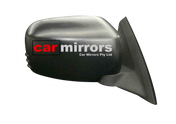
Driver Side vs Passenger Side Mirrors: The Difference
By Duber, The Car Mirror Man · Car Mirrors Australia · Updated August 2026 · 12 min read
Short answer: in Australia the passenger-side mirror is convex, which widens the field of view but makes objects appear further away than they are — hence the warning printed on it [1]. The driver's side is flat or nearly flat, giving true distance. The two are not interchangeable, and the curvature is specified per model.
In Melbourne? We can cut the correct curvature for each side at your home or work, anywhere across the metro — see our full Melbourne mirror service.
Most drivers use both mirrors thousands of times without ever noticing they are different. They are, in a way that changes how far away a car in the next lane actually is, and in a way that matters enormously when a piece of glass is being ordered. It is a five-minute thing to understand and it explains a surprising amount.
Flat, convex, and what each one buys you
Two shapes, two trade-offs, and no way to have both.

The warning — objects in mirror are closer than they appear — is not a disclaimer. It is a statement about the optics of a curved surface, and it is worth taking literally.
Right-hand drive, and why the sides are reversed from American advice
A frequent source of confusion when people read overseas material.
In Australia the driver sits on the right, so the driver's mirror is the right-hand one and the passenger's is the left. In the United States it is the reverse, and almost all mirror advice written online assumes their arrangement.
So “the passenger side is convex” is true in both countries, but the physical side of the car it refers to is opposite. When ordering glass, always specify driver's or passenger's rather than left or right, because it removes the ambiguity entirely.
It is also why we ask which side rather than assuming from a photograph.
Why the glass is not interchangeable
This is the practical consequence and the reason the article exists.
A convex panel in a driver's-side housing distorts distance where you most need it accurate.
Housings are handed. A left panel will not sit correctly in a right housing.
Where fitted, the element and connector are laid out to suit the side.
The clip pattern that engages the adjuster differs between sides.
A panel bought as “fits both sides” is a warning sign. Mirror glass is cut per model and per side, and anything sold as universal is by definition not cut to either.
Curvature is specified per model, not per side
A subtlety that catches people buying online.
It is not simply flat on one side and convex on the other. The radius of the convex panel is specified by the manufacturer for that model, and it varies. Two cars can both have convex passenger glass with meaningfully different radii.
A panel with the wrong radius fits the housing and looks entirely correct in the driveway. The difference shows up at speed, judging a gap, which is the worst possible moment to discover it.
Some driver's-side mirrors are convex too
Worth knowing, because it contradicts the simple rule.
A number of vehicles, particularly European models and larger vehicles, use a mildly convex or aspheric panel on the driver's side as well — sometimes with a visible dividing line, with a flat main section and a more curved outer strip.
Aspheric glass is a compromise: true distance across most of the panel, extra width in the outer portion where the blind spot sits. If your driver's mirror has a faint vertical line an inch or two from the outer edge, that is what you have.
It has to be replaced with the same type. A plain flat panel on a car that came with aspheric glass removes exactly the coverage that strip was there to provide.
Setting them properly
Since the two mirrors do different jobs, they should not be set the same way.
Lean your head until it almost touches the driver's window, then set the mirror so you can just see the side of your own car.
Lean to the centre of the car, then set it so you can just see your own flank.
Set to fill the rear window from your normal seating position.
The three fields of view overlap with far less blind spot than the conventional setting.
Most drivers set both side mirrors so they can see the rear corners of their own car, which duplicates what the interior mirror already shows and leaves the adjacent lanes uncovered. The setting above feels wrong for a week and then feels obvious.
Is the passenger mirror legally required?
On the great majority of vehicles in Australia, yes.
Victoria's roadworthiness standard requires external mirrors on both sides for any vehicle designed primarily for the carriage of goods, or any vehicle subject to internal rear vision obstruction [2]. Between those two categories sits nearly everything on the road.
The underlying design requirement comes from ADR 14 [3], which sets what mirrors a vehicle must be built with. The roadworthiness standard is what keeps them in usable condition afterwards.
Practically: if your car left the factory with two exterior mirrors, it needs two exterior mirrors.
What it costs to replace, either side
The price does not differ by side, only by what broke.
| What broke | Fitted price |
|---|---|
| Glass only, either side | from $135 |
| Cover, either side | $150–$300 |
| Full unit, plain | $200–$350 |
| Full unit, powered | $350–$500 |
| Driver-assist unit | $450–$600+ |
The driver's side is damaged more often than the passenger's on street-parked cars, for the obvious reason that it sits nearest the traffic lane. In carparks the ratio evens out.
Which side gets damaged, and where
A pattern worth knowing if you park on Melbourne streets.
Inner-suburb streets with a live traffic lane immediately beside parked cars — Fitzroy, Brunswick, Prahran, Carlton — produce far more driver's-side damage than anywhere else. Folding the mirrors is the whole defence, and it works.

The blind spot the mirrors were never going to cover
Worth being honest about, because no mirror setting eliminates it entirely.

Even with both side mirrors set wide and the interior mirror set correctly, there is a region beside and slightly behind the car that none of the three cover fully. It is the whole reason blind-spot monitoring exists as a product [4].
The mirrors are the tool. The head check is the backstop. Neither replaces the other, and drivers who have had blind-spot monitoring for years quietly stop doing the second one.
Why the passenger mirror gets ignored
A behavioural point that has a practical consequence for damage.
Drivers check the driver's mirror constantly and the passenger's mirror rarely, which means deterioration on the passenger side goes unnoticed for far longer. De-silvering, a chip, or a mirror that has drifted out of position can sit there for a year.
It is also the side that catches gateposts, garden walls and the kerb-side of narrow streets. More damage, less attention.
Worth deliberately looking at it once in a while, particularly the week before a roadworthy inspection — deterioration on either side is a fail [2].
Convex glass and towing, briefly
A question that comes up and has a short answer.
Convex glass widens the field of view, which is why it is on the passenger side. It does not extend the mirror further out from the car, and there is a limit to what curvature can do about a wide load behind you.
That is a different product category and not something we supply. What we do is exterior side mirror glass, covers and assemblies for the mirrors your vehicle came with.
Heating, on both sides
Since we are comparing the two sides, one practical difference worth noting.
Where a vehicle has heated mirrors, both sides are heated and they are wired to a single switch, usually the same one that runs the rear demister. A single mirror that no longer clears while the other does is a connector or element fault on that side, not a switch fault.
On a cold or damp Melbourne morning.
Both should be noticeably warm at the glass.
Element or connector on the cold side.
Switch, fuse or the shared circuit.
If a mirror was replaced recently and no longer heats, the most likely explanation is the simplest one: the element was not reconnected. It is a common omission and a two-minute fix.
The short version
Three things worth carrying away.
Set them wider than feels natural, look at the passenger side occasionally, and when you order glass say driver's or passenger's rather than left or right. Those three habits cover almost everything this article is about.

What the warning text actually means, numerically
Since it is printed on the glass, worth understanding what it is telling you.
A convex mirror compresses the scene. The wider field of view is bought by making everything in it smaller, and the brain reads smaller as further away. The effect is not subtle at the edges of the panel, which is exactly where an overtaking car appears.
May be closer to one.
Appears to close more slowly than it is.
Where the curvature is doing the most work.
It is the only view without an optical trade-off.
None of this is a fault. It is the deliberate design trade that gives you a usable near-side view at all, and it is why the warning is moulded into the glass rather than printed on a sticker [1].
When only one side needs replacing
A question people ask out of tidiness, and the answer is usually reassuring.
The one case for doing both is an older car where both panels have aged similarly and a roadworthy is coming. Otherwise, replace what broke.
What Melbourne drivers tell us
Getting the correct side and curvature is the whole job.
Every review quoted on this site is a real, verified customer review. We do not write them and we do not edit them.
Ordering the right part, first time
Four pieces of information, and it removes every common error.
Not left or right. It is unambiguous and it is what we work from.
It shows curvature type, any warning text, and any blind-spot indicator.
Model and build year decide the radius.
Or just tell us whether the car has a mirror-heating switch.
From those four we can supply the correct panel for your car and your side, cut to the right curvature, with the heating element matched. That is the whole difference between a mirror that is in the housing and a mirror you can drive by.
Every band above comes from our national price guide, which is the single source of truth for what we charge. If you want the full breakdown by part and by vehicle, read our side mirror replacement cost guide.
Frequently asked questions
Why does my passenger mirror say objects are closer than they appear?
Because it is convex. The curve widens the field of view, and the trade-off is that everything looks smaller and therefore further away than it is [1].
Are driver and passenger mirror glass interchangeable?
No. The curvature, the shape, the backing plate and the heating element layout all differ between sides, and the curvature is specified per model as well.
Which side is the driver's mirror in Australia?
The right-hand one, because Australia is right-hand drive. Most mirror advice written online assumes left-hand drive, so always specify driver's or passenger's rather than left or right.
Is the driver's mirror always flat?
Not always. Many European and larger vehicles use mildly convex or aspheric glass on the driver's side, sometimes with a visible dividing line near the outer edge.
Is a passenger-side mirror legally required?
On the great majority of vehicles, yes. Both sides are required for vehicles designed for carrying goods or subject to internal rear vision obstruction [2], which covers nearly everything on the road.
How should I set my mirrors?
Set each side mirror so you can only just see the side of your own car, with your head leaned toward that side. It overlaps far better with the interior mirror and leaves much less blind spot.
Does it cost more to replace one side than the other?
No. The price depends on which part broke, not which side it was on.
Can you tell which side I need from a photo?
Usually, but we still ask you to say driver's or passenger's. It takes a second and it removes the single most common source of a wrong part.
More on Melbourne mirrors
Based in Melbourne? These cover the rest of it.
Sources
- ADR 14/02 Rear Vision Mirrors, full technical text (PDF), Department of Infrastructure — www.infrastructure.gov.au/sites/default/files/migrated/vehicles/design/f
- VSI 26 Roadworthiness requirements, full text (PDF) — rear vision mirror clause — cdn-nrspp-s3-aus.s3.ap-southeast-2.amazonaws.com/wp-content/uploads/site
- Australian Design Rule 14/02 — Rear Vision Mirrors, Federal Register of Legislation — www.legislation.gov.au/Details/F2006L02663
- Wing mirror — history, design and regulation, Wikipedia — en.wikipedia.org/wiki/Wing_mirror
- Rear-view mirror — mount types and history, Wikipedia — en.wikipedia.org/wiki/Rear-view_mirror
- Australian Road Rules, National Transport Commission — www.ntc.gov.au/laws-and-regulations/australian-road-rules
- ADR 14/02 — current consolidated text, Federal Register of Legislation — www.legislation.gov.au/F2006L02663/latest/text
- Maintenance and repairs — your rights, Consumer Affairs Victoria — www.consumer.vic.gov.au/consumers-and-businesses/cars/maintenance-and-re
Prices and information in this article are indicative only and reflect real quoted jobs at the time of publication. Costs vary with vehicle, part availability and features. Send a photo for an exact fixed price.